What can you do when your child ignores a routine chart?
By Rachel Hassett ·
Last reviewed
If a visual routine chart is being ignored, check the pictures, number of steps, location, instructions and difficult jobs before abandoning it.
If your child ignores a routine chart, check whether they can understand it, reach it and use it without you translating every step. Then look at the job where the routine usually stalls.
The chart may need changing. That does not mean the whole idea has failed.
Check these five things first:
- Can your child find the routine?
- Do the pictures make sense to them?
- Is the list short enough to scan?
- Is one difficult job stopping everything?
- Do they know how to mark a job as done?
Is the routine easy to find?
Put the routine where the jobs happen and where the child can reach it.
A chart hidden behind a door or a digital board kept on a parent’s phone cannot do much prompting on its own. For All Set, a shared tablet in a predictable place may be easier for a child to return to during the routine.
All Set is browser-based and needs an internet connection. Device and browser compatibility varies, so check an older device before relying on it.
Are the pictures clear to your child?
The picture needs to mean the job to the child using it.
A general backpack image may work. A photo of their actual school bag may work better. If your child keeps asking what a card means, change the picture or the task name instead of repeating the same explanation forever.
All Set lets parents use built-in pictures and upload their own photos. See how to choose pictures your child can recognise.
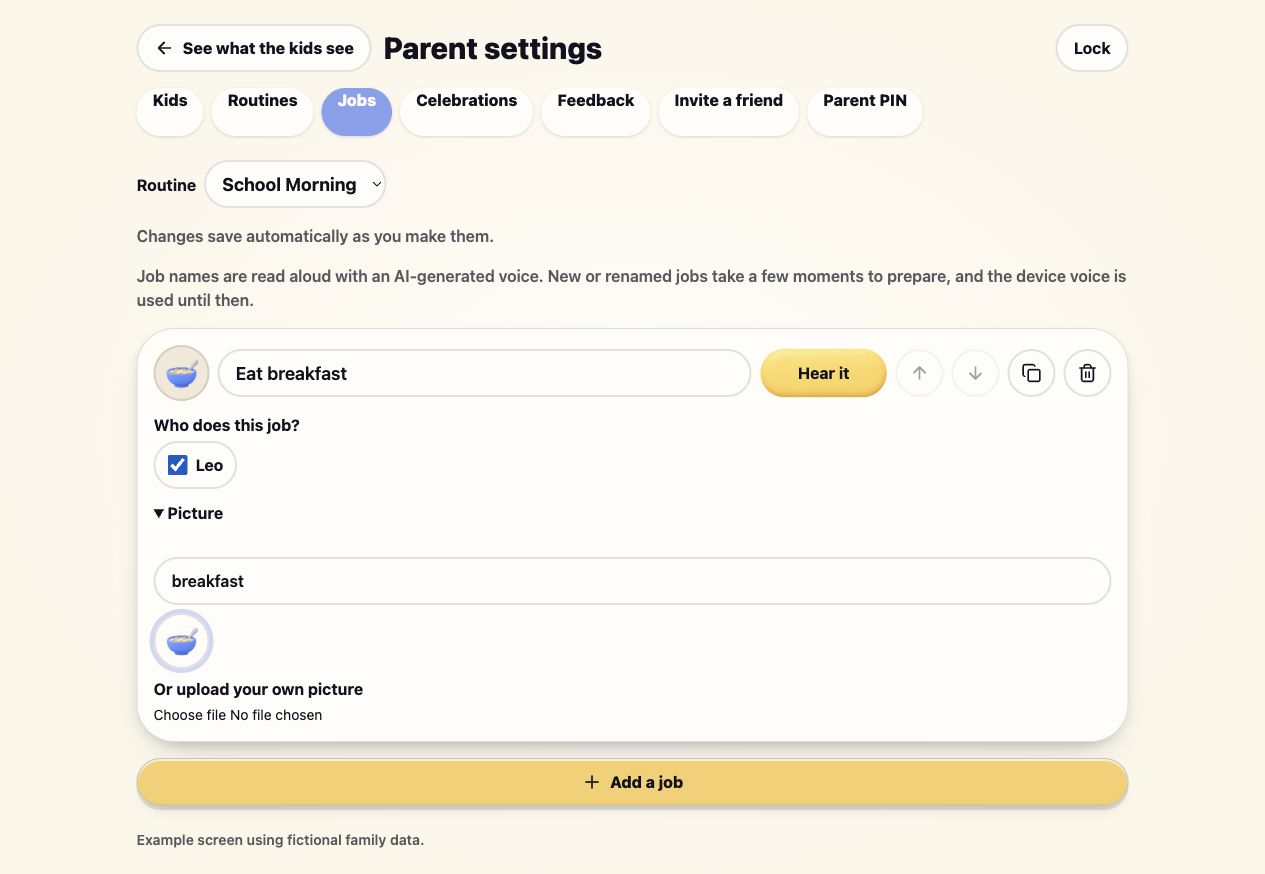
Example screen using fictional family data.
Is the routine too long?
Try removing steps that do not need to be visible yet.
A routine can become another wall of instructions when every tiny action gets its own card. Start with the jobs that regularly need prompting. Add more only when the child is comfortable with the first version.
Some jobs can also be split. “Get ready for school” may be too broad, while “get dressed” and “put on shoes” are easier to act on.
Is one particular job causing the stop?
Watch where the routine loses momentum.
For example, your child might tick off breakfast and teeth but still need help getting dressed. That gives you a particular job to look at, rather than a reason to abandon the whole board.
That job may need a clearer picture, a smaller step or adult help. A routine board can show what comes next without making every task easy.
Does your child know what to do with the chart?
Show them how the board works when you are not already racing out the door.
With All Set, that means looking at the picture, tapping Hear it if needed, doing the job and ticking it off. The child can then see their progress update.
You may still need to redirect them to the board. The useful change is that the next step has somewhere visible to live.
Would a different order help?
Some children work better when the next job is fixed. Others are happier choosing from the jobs that are left.
All Set supports both approaches. See when to use fixed order or any order, then watch where your child still needs help.
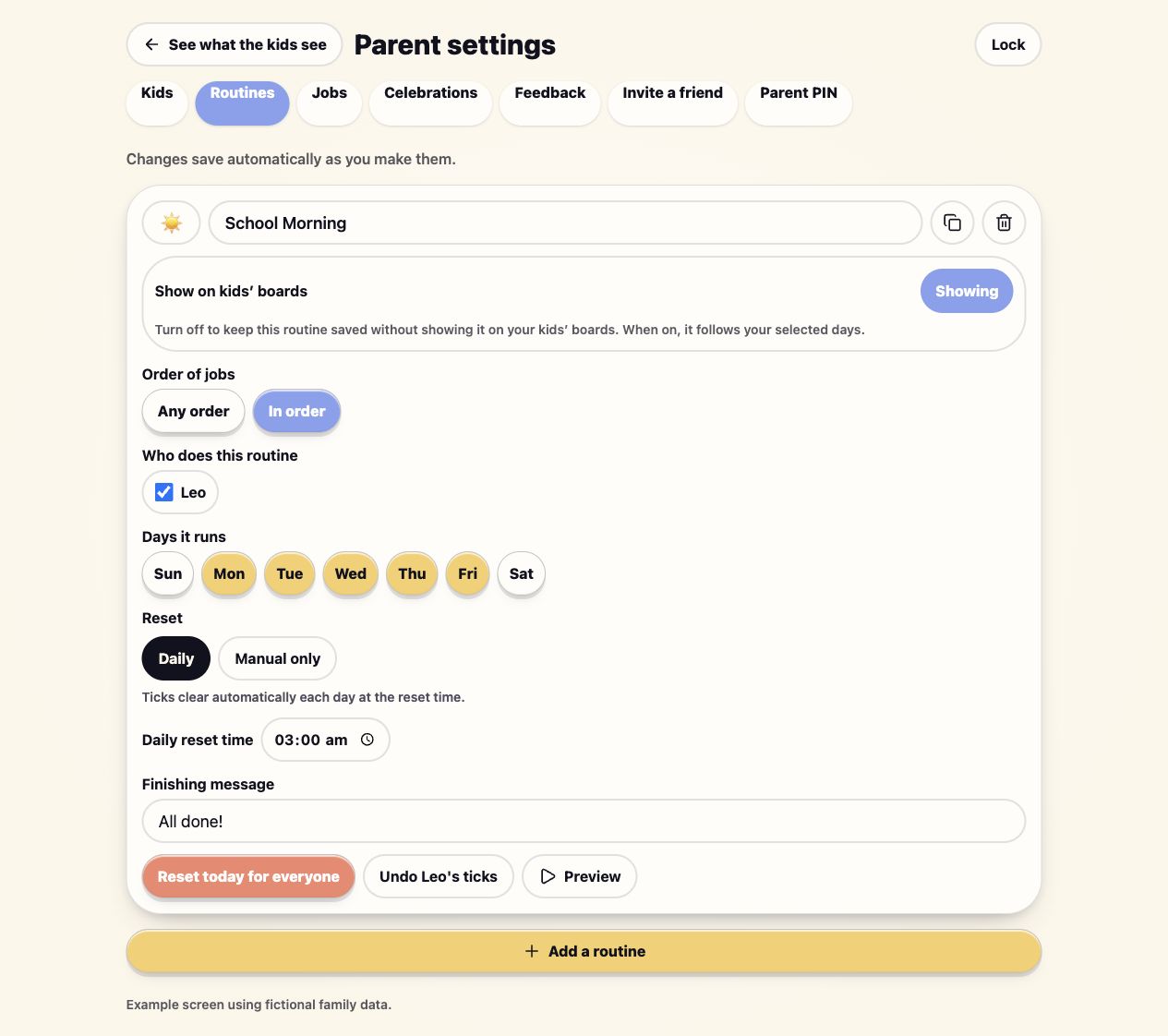
Example screen using fictional family data.
Are the celebrations helping or distracting?
All Set can respond to completed jobs with silly sounds and visual celebrations.
Celebrations can be configured. If a response is not useful in your household, change it. The board still needs to make sense without relying on confetti to do all the heavy lifting.
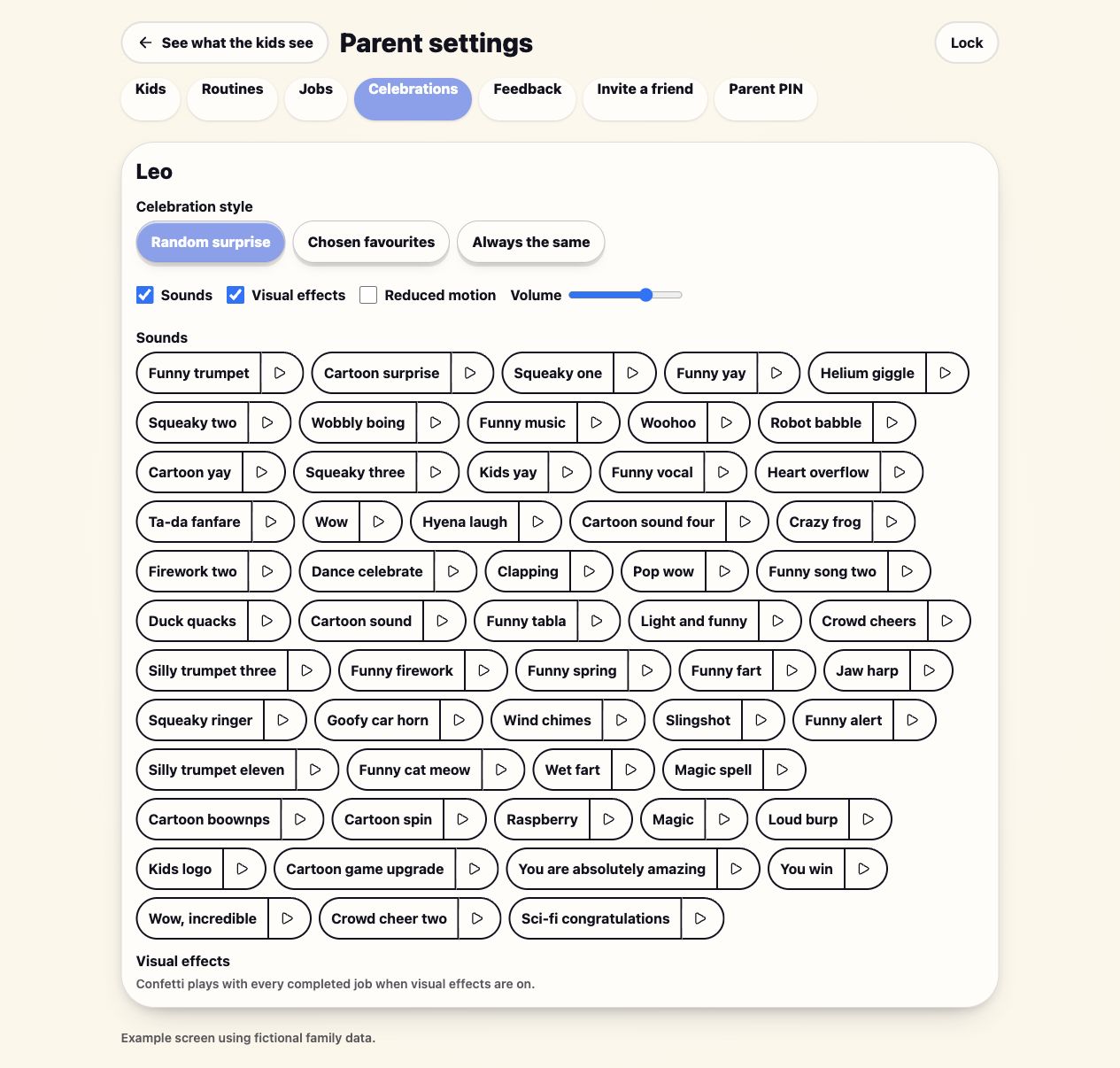
Example screen using fictional family data.
When should you simplify or stop?
If maintaining the chart creates more work than it removes, simplify it.
Use fewer jobs. Try one routine instead of the whole day. Change the format if your child responds better to paper, Velcro or verbal support. The printable, Velcro and digital comparison explains the practical trade-offs. All Set will not suit every family, especially one needing a completely offline tool.
The point is to give the routine a visible home, not to win an argument with a chart.
See how All Set works and check the supported device information before deciding.